IN THE BEGINNING
Chrysler’s plan, approach and success to dominate pro stock
It is 1970 and NHRA has just certified Pro Stock as its third professional category. All of the American factory hot rod muscle cars are represented. Names like Jenkins, Hutter for Chevy; Nicholson, Glidden for Ford; Booth, Maskins & Kanner for AMX, with Sox& Martin and other Works teams for Chrysler all vying to be top gun. However only Sox & Martin and the Works teams had a secret weapon to win the racing wars against all the competitors!
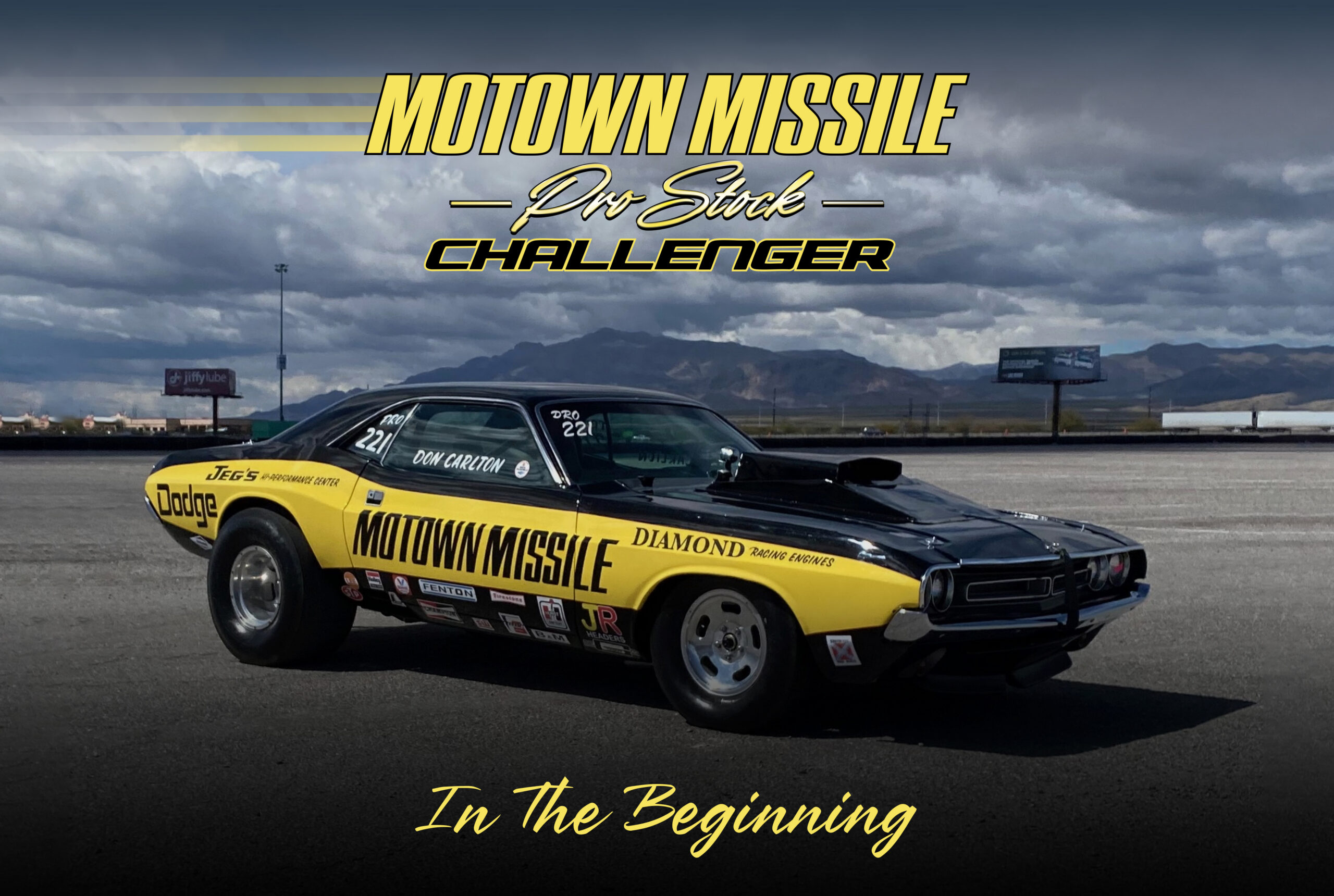
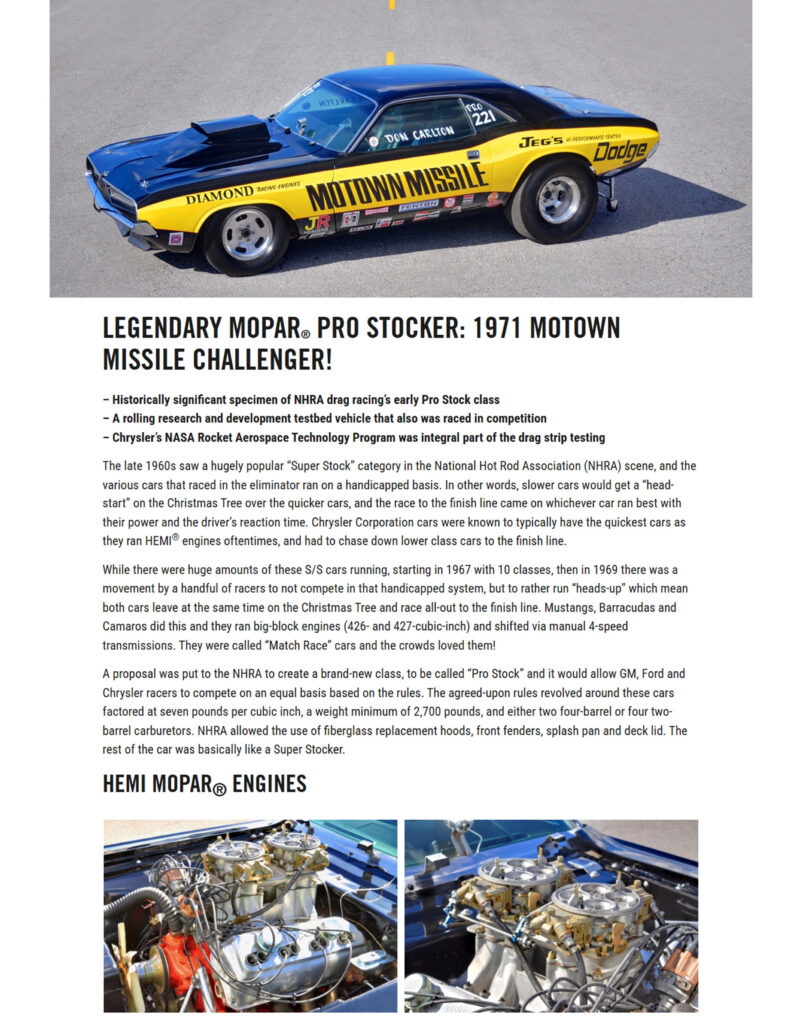
Enter the MOTOWN MISSILE. Just as the U.S. government had its Skunk Works which pushed technology development into the realm of the unknown--the U-2, the SR-71 Blackbird, Stealth Fighter----so did Chrysler. In a non-descript building in Detroit was Mopar’s Skunk Works of advanced Pro Stock Technology, its special Vehicle Engineering Group. Its SR-71 Blackbird was the MOTOWN MISSILE -- a 1970 Dodge Challenger purposefully built as a rolling testing lab.
The MOTOWN MISSILE team of engineers, mechanics, and driver stood out from the crowd with an unlimited amount of advanced thinking, technology, and exotic materials that was developed for the Motown Missile team car. The top secret was Chrysler’s Huntsville Space Company and its contribution to Nasa’s Apollo and other space related technologies applied to the car. Never before had so much science been applied to every aspect of racecar development and construction. The engineering, technology and performance enhancement techniques developed in the Missile Program was transferred to all of the factory-backed Works teams that caused them to dominate Pro Stock racing.
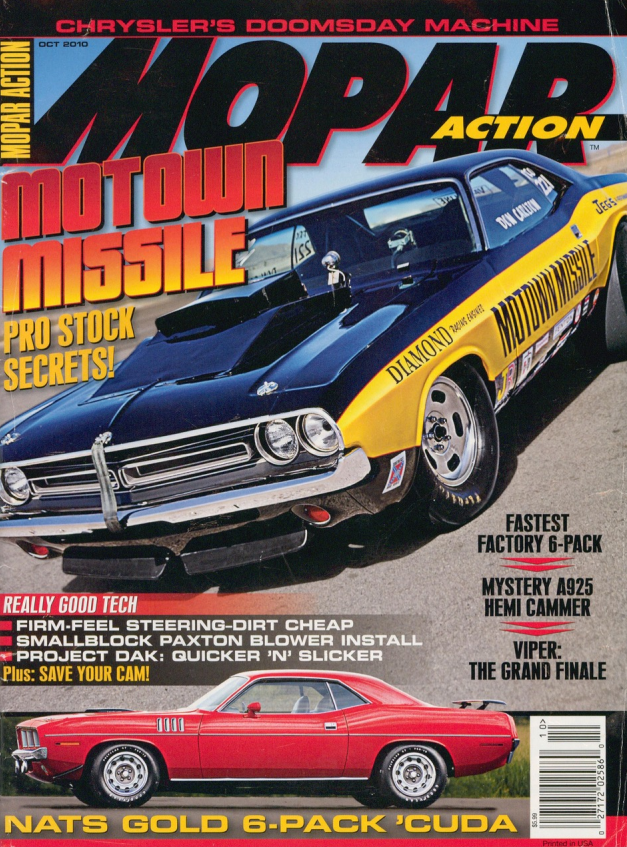
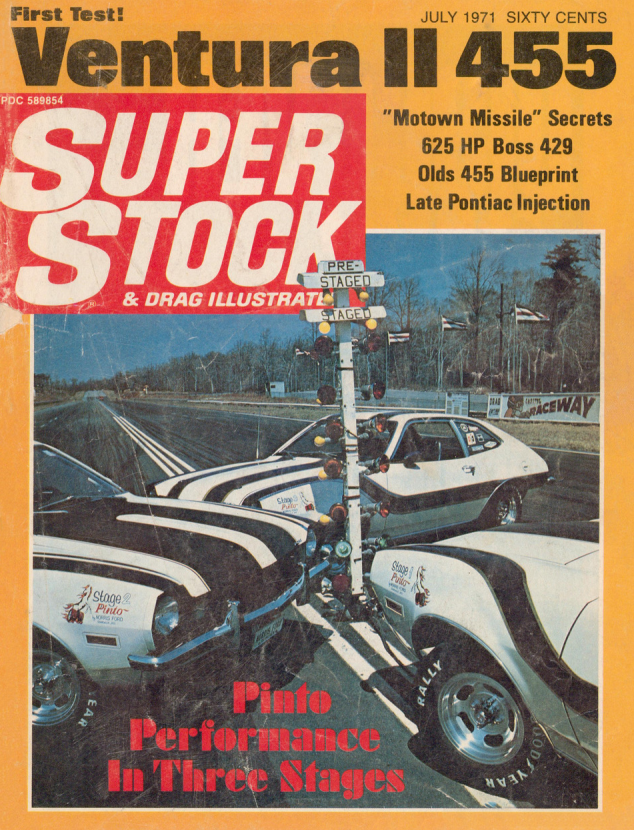
Technology development was what made Chrysler as a corporation stand out, and the MOTOWN MISSILE was the car that all the racers idolized. The car magazines of the day ran numerous feature articles on the car, the people and companies behind them. The MOTOWN MISSILE program, team, and sponsors were regarded with the same sense of awe typically reserved for the space program. THE MOTOWN MISSILE DELIVERED!
Genesis of a Legend
Click Arrow to Flip Pages
Tom Hoover - The MAN, THE MYTH, THE LEGEND
The driving force behind the Motown/Mopar Missile Program
Tom is known as the “Hemi Godfather,” was one of the most legendary engineers in American high-performance automotive history. As a leading engineer for Chrysler Corporation during the 1960s horsepower wars, Hoover became closely associated with the development of the iconic Chrysler 426 HEMI, one of the most feared and successful racing engines ever produced.
Hoover played a dominant role in Chrysler’s factory racing programs at a time when competition between Detroit manufacturers was at its absolute peak. His engineering work helped Chrysler dominate both drag racing and NASCAR competition with brutally powerful Mopar engines.
He led the development of Chrysler’s Pro Stock effort and oversaw the evolution of the MOTOWN MISSILE Pro stock Program that provide the source of Chrysler’s dominance in the class.
Before the arrival of the famous 426 HEMI, Hoover was heavily involved in the Max Wedge racing program, where Chrysler developed highly aggressive big-block drag racing engines specifically engineered for quarter-mile competition. The lessons learned from those engines helped shape the development of the later HEMI program.
One of Hoover’s defining strengths as an engineer was his deep understanding of airflow and combustion efficiency. He recognized the enormous potential of hemispherical combustion chamber design for producing high horsepower and maintaining durability under extreme racing conditions.
The 426 HEMI became legendary because of its massive valves, exceptional breathing capability, high-RPM strength, and ability to survive brutal competition use. Under Hoover’s leadership and engineering influence, the HEMI evolved into one of the most dominant engines in motorsport history.
Another defining characteristic of Hoover’s work was his practical racing philosophy. He believed in aggressive real-world testing and direct motorsport validation rather than relying purely on laboratory theory. This hands-on approach contributed heavily to Chrysler’s racing success.
The HEMI’s victories in NASCAR, NHRA drag racing, and street performance culture eventually cemented both the engine and Hoover himself as icons of the muscle car era. Beyond engineering, Hoover became deeply respected within the Mopar community for his passion, technical knowledge, and direct connection to Chrysler’s golden age of performance development.
Motown Missile in the News
Investment Rationale
Copright 2026. All rights reserved. Any and all uses of the Motown Missile trademarked name, and any derivations of including Motown Missile Challenger, Motown Missile Pro Stock Challenger, Motown Missile Cuda, and Motown Missile Pro Stock Cuda including uses in conjunction with diecast or moulded cars, trucks, clothing, oil and chemicals, and other apparel are trademarked and not allowed without express written permission.